
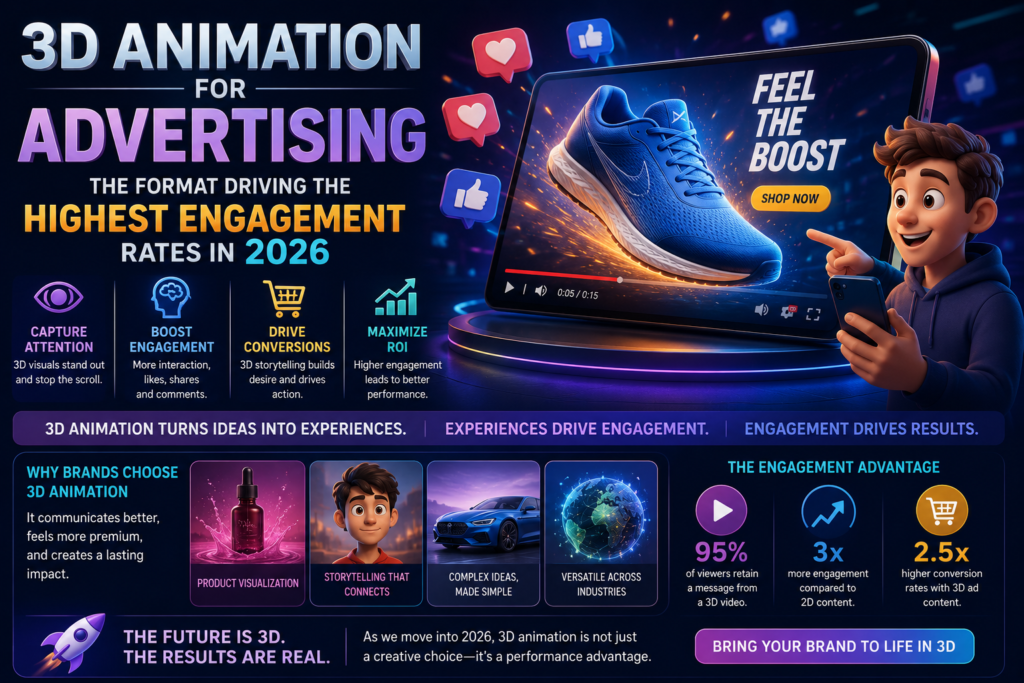
3D Animate US | Published: Monday, April 14, 2026 | Keyword: 3D animation for advertising campaigns 2026 | ~1,900 words
Digital advertising in 2026 is a performance discipline. Every creative decision — format, duration, opening frame, audio treatment, call to action — is measurable, testable, and accountable to the metrics that determine whether a campaign delivers ROI or consumes budget without result. In this environment, format selection is not a creative preference. It is a commercial decision.
The data on 3D animated advertising creative is increasingly clear: across the major paid digital channels — Meta, TikTok, YouTube, connected television, programmatic display, LinkedIn — 3D animation outperforms static and standard video creative on the metrics that determine advertising efficiency. Higher thumb-stop rates. Lower cost per click. Higher click-through rates. Better conversion rates on landing pages receiving animated traffic. Stronger brand recall in post-campaign research.
This article examines why 3D animation performs the way it does in advertising contexts, how to deploy it effectively across the major paid channels in 2026, and what the production and strategic considerations are for brands making the shift from standard creative to 3D animated advertising.
Why 3D Animation Outperforms in Paid Advertising

The performance advantage of 3D animation in advertising is not random. It has structural causes rooted in how the human visual system processes different types of content — causes that are consistent across audiences, cultures, and advertising platforms.
The Motion and Depth Interrupt
In a feed environment — scrolling through a social media platform, browsing a content page, viewing a connected television interface — the human visual system is constantly making rapid assessments of what warrants attention and what can be filtered out. Static images, which have been the dominant digital advertising format for two decades, have trained audiences to filter them efficiently. The brain recognizes a rectangular static image in peripheral vision and largely dismisses it before it registers consciously.
3D animation breaks this filtering pattern in two ways simultaneously. Motion captures attention at a neurological level — the visual system is hardwired to prioritize moving stimuli as a survival mechanism, and this mechanism operates below the threshold of conscious decision-making. Depth cues — the shadow movement, highlight shifts, and perspective changes produced by a rotating 3D object — trigger additional perceptual processing because the brain interprets them as signals of spatial reality. The combination of motion and depth is attention-commanding in a way that neither element is alone.
The Novelty Factor
3D animated advertising creative, while growing in prevalence, is still sufficiently uncommon in most advertising categories that its visual register constitutes a genuine pattern interrupt. A consumer scrolling through a feed of photography-based product ads encounters a 3D animated product visualization and their visual system registers it as categorically different from the surrounding content. This novelty advantage is not permanent — as 3D animation becomes more widespread, the novelty effect will diminish. Brands that establish 3D animation as part of their creative identity now will hold an attention advantage for years after the format becomes standard.
Greater Visual Information Density
A 3D animated product video communicates more information about a product in three seconds than a static photograph can communicate in any amount of exposure time. In three seconds of 3D animation, a viewer sees the product from multiple angles, observes its surface materials in different lighting conditions, understands its proportions in three-dimensional space, and — if the animation includes a brief product feature demonstration — understands something about how it works. This information density reduces the cognitive effort required to form a purchase consideration, which is the cognitive precondition for clicking an ad.
| Advertising performance is ultimately a function of attention captured multiplied by relevance communicated multiplied by friction eliminated. 3D animation improves all three variables simultaneously — which is why its impact on campaign metrics is so consistently positive. |
Platform-by-Platform: 3D Animation Advertising in 2026
Let’s explore the various platforms that can be used for paid advertising today.
Meta (Facebook and Instagram)
Meta’s advertising ecosystem rewards creative that generates engagement in the first three seconds of exposure. 3D animated product content — particularly product visualizations that rotate or transform immediately from the first frame — consistently generates higher thumb-stop rates than equivalent static creative in Meta placements. The platform’s algorithm amplifies content that earns engagement, creating a compounding organic reach benefit for high-performing 3D creative.
For Reels and Stories placements, the vertical format (9:16) requires that 3D animated content be produced in or adapted to vertical composition. Brands that produce 3D animation in a widescreen format only, and then crop it for vertical placements, consistently underperform against brands that produce vertical-native 3D content. This is a brief specification decision that should be made before production begins.
TikTok
TikTok’s algorithm is the most content-performance-driven of the major social platforms — the quality of the content, measured through completion rate and engagement, determines reach more directly than on any other channel. 3D animated content that is visually compelling enough to drive high completion rates on TikTok can achieve significant organic amplification even in paid placements.
The creative register on TikTok rewards a slightly more energetic visual style than other platforms — faster pacing, bolder transitions, more dynamic camera movement. 3D animation produced for TikTok should be briefed with this platform aesthetic in mind rather than adapted from a widescreen brand film production.
YouTube and Connected Television
YouTube pre-roll and connected television placements operate on a different attention model from social feed advertising. The viewer is in a lean-back mode — they have chosen to watch content and are passively receptive to what appears before it. In this context, 3D animation’s advantage shifts from pure attention capture to sustained visual quality: the ability to maintain the viewer’s interest through a 15 or 30-second pre-roll that earns a brand impression rather than triggering a skip.
For connected television specifically — where ads appear on large-screen environments and viewers are often in a shared viewing context — 3D animation’s photorealistic quality is visually pronounced. The production standard of the advertising communicates brand quality in a large-screen context in a way that is qualitatively different from its appearance on a mobile device.
LinkedIn’s advertising environment is the highest-value paid channel for B2B brands — and it is an environment where 3D animation’s professional production quality signal is most commercially significant. A 3D animated product demonstration in a LinkedIn feed reaches decision-makers and procurement leads in a professional mindset, and the quality of the creative communicates something about the brand’s operational standards that a screenshot or static graphic cannot.
LinkedIn’s algorithm favors native video over external links, and 3D animated video content uploaded natively to the platform consistently achieves better organic reach than equivalent static content. For B2B brands whose target audience is concentrated on LinkedIn, 3D animation is one of the highest-leverage content investments available.
Programmatic Display and Digital Out-of-Home
3D animation is increasingly deployable in programmatic display environments — including rich media banner formats that support video or HTML5 animation. A 3D animated product visualization in a rich media banner outperforms static display creative on click-through rate in every category where the comparison has been tested. Digital out-of-home displays — large-format screens in retail, transit, and venue environments — are native environments for 3D animation, where the format’s visual scale and motion quality are most fully expressed.
Building a 3D Animated Advertising Creative Strategy
The brands seeing the strongest returns from 3D animation in advertising are not those that simply replace their static creative with 3D animated equivalents. They are those that build a creative strategy around the format — treating 3D animation as a content infrastructure from which multiple campaign assets are derived.
| Strategic Asset | What It Produces |
| Hero product 3D model | 360-degree spin for e-commerce; photorealistic stills for display; AR viewer; packaging mockup |
| 15-second core creative | Full-length social ad; 6-second bumper cut; silent social version; connected TV pre-roll |
| Product feature animation | Standalone feature explainer; mid-funnel email content; sales deck embed; trade show display |
| Brand environment | Multiple product placements in same environment; seasonal variant updates; localized versions |
| Character or mascot | Campaign series continuity; platform-specific character behaviors; long-term brand equity |
This asset-infrastructure approach means that the economics of 3D animation in advertising improve significantly at volume. The initial investment in high-quality 3D models and brand environments produces a library of assets that can be deployed, adapted, and refreshed across campaigns without re-commissioning the underlying production.
Production Considerations for Advertising-Specific 3D Animation

3D animation produced for advertising has specific requirements that differ from production for other contexts. These should be addressed in the brief to avoid costly post-production format corrections.
- Format-first production: Brief for all required aspect ratios from the start. Producing in 16:9 and cropping to 9:16 wastes the visual composition advantages of 3D animation. If the campaign requires vertical, horizontal, and square formats, brief for all three.
- Silent-first optimization: A significant proportion of social media advertising is viewed with sound off. The core message of the animation — the product, the feature, the brand value — should be communicable without audio. Subtitles or on-screen text should be planned in production, not added as an afterthought in post.
- First-frame as hero: In autoplay environments, the first frame of the animation is the thumbnail. It should be the strongest possible visual — the product at its most compelling angle, or the most attention-commanding frame in the animation. Brief the studio explicitly on this requirement.
- Compression tolerance: Advertising platforms apply varying degrees of video compression to uploaded creative. Brief the studio to produce at the highest practical source quality and test compressed versions before campaign launch.
- Platform-specific duration: Produce to platform specifications: 6 seconds for bumper ads, 15 seconds for standard pre-roll, 30 seconds for extended pre-roll, 60–90 seconds for mid-funnel social content. Each duration requires a distinct creative structure.
The Competitive Window Is Now
The performance advantages of 3D animation in digital advertising are real and measurable in 2026. They are also, for the moment, advantages that the majority of brands in most categories have not yet captured. The competitive window for early-mover advantage — the period during which 3D animated creative stands out precisely because it is not the category standard — will not stay open indefinitely.
Brands and agencies that build their 3D animation content infrastructure now will hold a compounding competitive advantage: better creative performance driving lower advertising costs, a growing asset library enabling more efficient production at scale, and a visual brand identity built around a format that earns attention in the channels where their competitors are still competing on static imagery.
3D Animate US produces 3D animated advertising creative for brands and agencies across the United States — from single-format social ads to full multi-platform campaign productions. Contact our team to discuss your next campaign.