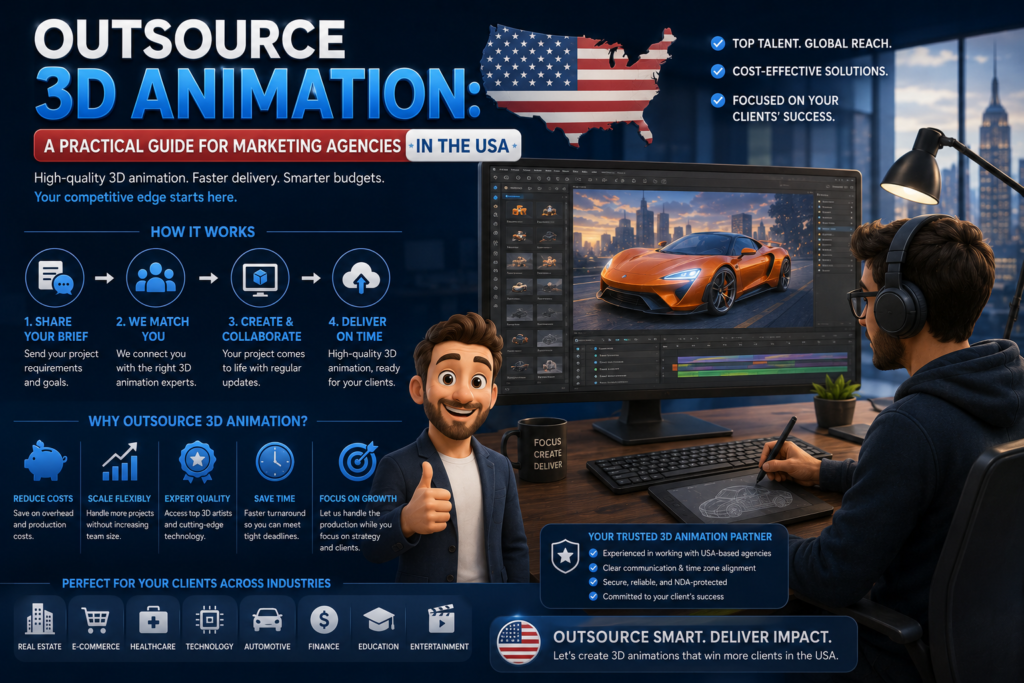
The case for outsourcing 3D animation is straightforward for most marketing agencies: the capability is expensive to build in-house, the demand from clients is growing, and the quality gap between specialist studios and generalist production is commercially significant in a way that clients increasingly notice. What is less straightforward is the operational reality of outsourcing animation production effectively — managing the workflow, maintaining client confidentiality, ensuring quality consistency, and building the kind of studio relationship that makes future projects progressively smoother.
This guide addresses the operational side of outsourcing 3D animation for U.S. marketing agencies. It covers how to structure the relationship, how to manage the handoff and review process, how to protect client IP throughout, how to price the engagement for the agency’s P&L, and how to identify the warning signs that a studio relationship is not working before it produces a client-facing problem.
Build-vs-Buy: Why Most Agencies Should Outsource
Some agencies reach a point where 3D animation volume justifies an in-house capability. A digital production agency producing ten or more 3D animation projects per month, with consistent style requirements and predictable production scopes, may find that building a small in-house team is economically rational. This is the exception, not the rule.
For the majority of marketing agencies — even those with significant revenue and established client rosters — the economics of in-house 3D production are unfavorable. A professional Maya animation setup requires software licensing, render farm infrastructure, and a minimum of two to three specialist artists covering modeling, rigging/animation, and lighting/compositing. The annual cost of that capability — salary, benefits, equipment, software, and overhead — typically exceeds $400,000 before a single frame is rendered.
At the project volumes most agencies operate, this fixed cost produces a prohibitive cost-per-deliverable that no client brief can justify. Outsourcing converts that fixed cost into a variable one — paying for production only when there is a client project to produce it for, and accessing senior specialist capability without the overhead of employment.
| The most financially rational agency structure for 3D animation is: zero fixed production overhead, variable access to specialist capability, and a mark-up model that generates margin on production cost without requiring in-house investment in the tools or talent that produce it. |
Structuring the Studio Relationship
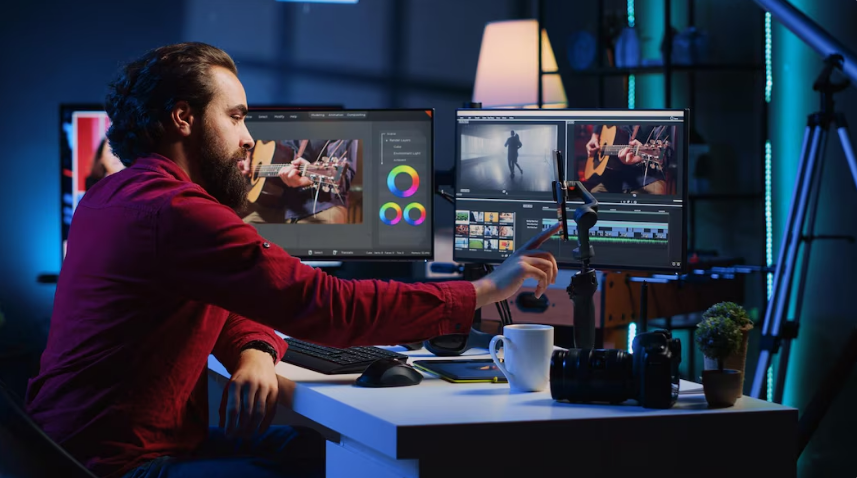
The outsourcing relationship for 3D animation is most effective when it is structured as a genuine partnership rather than a transactional vendor arrangement. Agencies that invest in building a genuine working relationship with their studio partner — with shared understanding of the agency’s client standards, brand guidelines, and production preferences — see progressively better output on each subsequent project.
Choosing the Right Studio
The studio selection process for agency outsourcing has specific requirements that differ from a direct brand client selection. The relevant criteria for agency partnerships include:
- White-label experience: Has the studio produced work for agencies before, operating under agency branding throughout the process? Ask specifically.
- NDA and confidentiality standards: Does the studio have standard NDA documentation that covers all client IP, brand assets, product designs, and campaign strategy? This is a non-negotiable requirement before any client materials are shared.
- Communication professionalism: In a white-label model, all client communication runs through the agency. The studio must be able to produce clear, timely, professional communication that the agency can relay to clients without editing or translation.
- Production process transparency: The agency must be able to tell its client where the project stands at any given moment. A studio with clear milestone reporting and reliable WIP delivery makes this straightforward.
- Quality consistency: The studio’s delivered work should be consistent with its portfolio. Ask for references from agency clients specifically, and inquire about their quality review processes.
- Capacity and scalability: Can the studio handle volume growth as the agency’s 3D offering develops? A studio at capacity on its existing workload is a bottleneck risk as the agency scales.
Formalizing the Relationship
Before the first project brief is shared, the agency-studio relationship should be formalized through two documents: a master services agreement that covers the ongoing commercial terms of the relationship, and a mutual non-disclosure agreement that covers all client materials shared in the course of the engagement.
The master services agreement should define payment terms, IP ownership standards (all work product transfers to the agency upon full payment, without reservation), revision policy, deliverable standards, and the terms under which the agency may engage the studio on behalf of multiple clients. The NDA should cover both parties’ confidential information and specifically reference the protection of third-party client materials.
The Brief-to-Delivery Workflow
The production workflow for agency-outsourced 3D animation has a specific structure that protects the client relationship while enabling smooth production collaboration between the agency and studio.
| Workflow Stage | Agency Responsibility | Studio Responsibility |
| Client brief development | Develop full client brief; translate into production brief for studio | Receive production brief; ask clarifying questions through agency; confirm scope and timeline |
| Quote and scope | Review studio quote; mark up for client; present to client as agency proposal | Provide detailed scope and quote based on production brief |
| Contract and onboarding | Sign production agreement with studio; share brand assets and product reference under NDA | Sign NDA; receive assets; confirm production kickoff |
| Pre-production review | Review storyboard and animatic; consolidate internal + client feedback; pass consolidated brief to studio | Produce storyboard and animatic; revise based on consolidated agency feedback |
| WIP reviews | Review WIP deliverables; QA against brief; consolidate client feedback; pass to studio as single brief | Produce WIP deliverables at agreed milestones; revise based on agency-consolidated feedback |
| Final delivery | Review final deliverable; conduct QA; deliver to client under agency brand | Deliver final files and high-resolution master to agency; provide asset handover documentation |
The critical discipline in this workflow is feedback consolidation. All client and internal feedback must be consolidated by the agency before it reaches the studio — the studio should receive one set of notes per review round, not a stream of individual stakeholder emails. Studios that receive unconsolidated feedback produce revision cycles that are more expensive and less efficient than those receiving consolidated briefs.
Protecting Client IP Throughout the Engagement

Client IP protection is the most legally and commercially sensitive aspect of agency outsourcing. Marketing agencies operate under confidentiality agreements with their clients that typically prohibit sharing client materials — brand assets, product designs, campaign strategy, unreleased product information — with third parties without the client’s explicit consent or a contractual framework that provides equivalent protection.
The NDA between agency and studio provides this contractual framework — but it only protects materials that are explicitly covered by its terms and shared through appropriate channels. The following practices reinforce IP protection throughout the engagement.
- Share only what is necessary: The studio needs enough reference to produce the animation accurately. It does not need access to the client’s broader brand strategy, internal communications, or commercial roadmap. Apply the minimum-necessary principle to all information sharing.
- Use generic project identifiers: For particularly sensitive projects — pre-launch product campaigns, confidential brand extensions, competitive market entries — consider using a project codename rather than the client’s brand name in production communications.
- Retain control of master files: Ensure the contract specifies that all 3D project files and source assets are delivered to the agency at project completion, and that the studio does not retain or re-use client-specific assets for any purpose.
- Brief the studio on photography and reference: If the project involves unannounced product designs or unreleased campaign creative, explicitly brief the studio on the sensitivity of these materials and ensure the NDA’s confidentiality terms are understood before any reference is shared.
Pricing the Outsourced Engagement for Agency Margin
The pricing model for agency-outsourced 3D animation follows the same structure as any outsourced production service: the agency pays the studio’s production rate and marks up that rate to the client to reflect the agency’s contribution.
The appropriate mark-up range depends on the agency’s service model, the complexity of its contribution, and the nature of the client relationship. Agencies providing full creative direction, client management, brief development, and QA on top of production coordination typically apply mark-ups in the 30–50% range above the studio’s production cost. Agencies acting primarily as pass-through coordinators with lighter creative contribution may apply narrower mark-ups.
The mark-up should be presented to the client as the agency’s production rate — not as the studio’s rate with an itemized mark-up disclosed. The agency is selling a production service, not acting as a broker. The studio relationship is the agency’s operational infrastructure, equivalent to any other internal tool or resource that the agency does not itemize in its client billing.
| Studio Production Cost | Agency Mark-up Range (30–50%) | Client-Facing Rate |
| $8,000 | $2,400 – $4,000 | $10,400 – $12,000 |
| $15,000 | $4,500 – $7,500 | $19,500 – $22,500 |
| $25,000 | $7,500 – $12,500 | $32,500 – $37,500 |
| $40,000 | $12,000 – $20,000 | $52,000 – $60,000 |
Warning Signs That a Studio Relationship Is Not Working
Agency-studio relationships that are not functioning well produce predictable warning signs. Recognizing them early — before they create client-facing problems — is the difference between a recoverable situation and a damaging one.
- Missed WIP deadlines: A studio that delivers work-in-progress reviews late once has a capacity or workflow problem. A studio that does it repeatedly is not organized to support a professional agency relationship. Address it directly and immediately; do not rationalize it.
- Quality drift: If the quality of delivered work is consistently lower than the quality of the studio’s portfolio or previous deliverables, investigate immediately. Quality drift is a signal of changing personnel, overcommitted capacity, or declining production standards.
- Communication gaps: Long response times, unclear answers to direct questions, or evasiveness about production status are reliability signals. A studio that cannot communicate clearly in pre-production will communicate worse under production pressure.
- Scope expansion without proactive notice: If a project is running over scope or timeline, the studio should flag it proactively — not wait for the agency to ask. Studios that surface scope issues late are managing the relationship poorly.
- Confidentiality boundary violations: Any indication that client materials have been referenced in studio portfolio work, discussed in external contexts, or shared beyond the production team is a serious breach that requires immediate action.
The Partnership That Compounds
The agencies that get the most value from outsourced 3D animation are not those that treat every project as a discrete transaction. They are those that invest in building genuine production partnerships — with studios that know their clients’ standards, understand their briefing style, and deliver progressively better output as the relationship matures.
This investment pays compounding returns: faster production timelines as the studio learns the agency’s expectations, lower revision cycle costs as alignment improves, and — eventually — a studio partner that proactively contributes creative ideas to the agency’s client work rather than simply executing briefs. That level of partnership is the most commercially valuable studio relationship an agency can build.
3D Animate US is a U.S.-based studio with an established agency partnership program. If you are evaluating outsourcing partners for 3D animation production, contact our team to discuss the model and review our production credentials.