The word ‘affordable’ means something specific when you are a small business owner with a real budget, real priorities, and a marketing team that might just be you. It does not mean cheap. It does not mean compromised. It means getting genuine value — commercially useful output — at an investment level that makes financial sense for where your business is right now.
3D animation has historically been associated with large production budgets and enterprise clients. That association is increasingly outdated. The democratization of 3D production tools, the growth of specialist studios serving the small business market, and the compounding reusability of digital assets have changed the economics significantly. Professional-quality 3D animation is now genuinely accessible to businesses at the growth stage — if you know what you are buying, how to scope it, and how to choose the right partner.
This guide is written specifically for small business owners and growth-stage founders. It tells you what 3D animation can realistically do for your business at different investment levels, where the genuine value opportunities are, and how to build a production approach that fits your budget without compromising on the outcomes that matter.
First: Reframe What ‘Affordable’ Means for Animation

Most small business buyers approach 3D animation with one of two flawed frameworks. The first is the race-to-bottom instinct: find the cheapest option that technically qualifies as 3D animation, deploy it, and judge the format by that output. The second is the all-or-nothing fallacy: conclude that because cinematic 3D production is expensive, 3D animation is not accessible at all.
Both frameworks produce bad decisions. The right framework is return on investment. The relevant question is not ‘what is the cheapest 3D animation I can buy?’ — it is ‘at what investment level does 3D animation produce a measurable return for my specific business objective?’ That reframe opens up a genuinely useful conversation about scope, strategy, and value.
| Affordable does not mean inexpensive. It means that the outcome you are buying justifies the investment required to achieve it. That calculation looks different for every business — and it always starts with a clearly defined objective. |
What 3D Animation Can Do for a Small Business

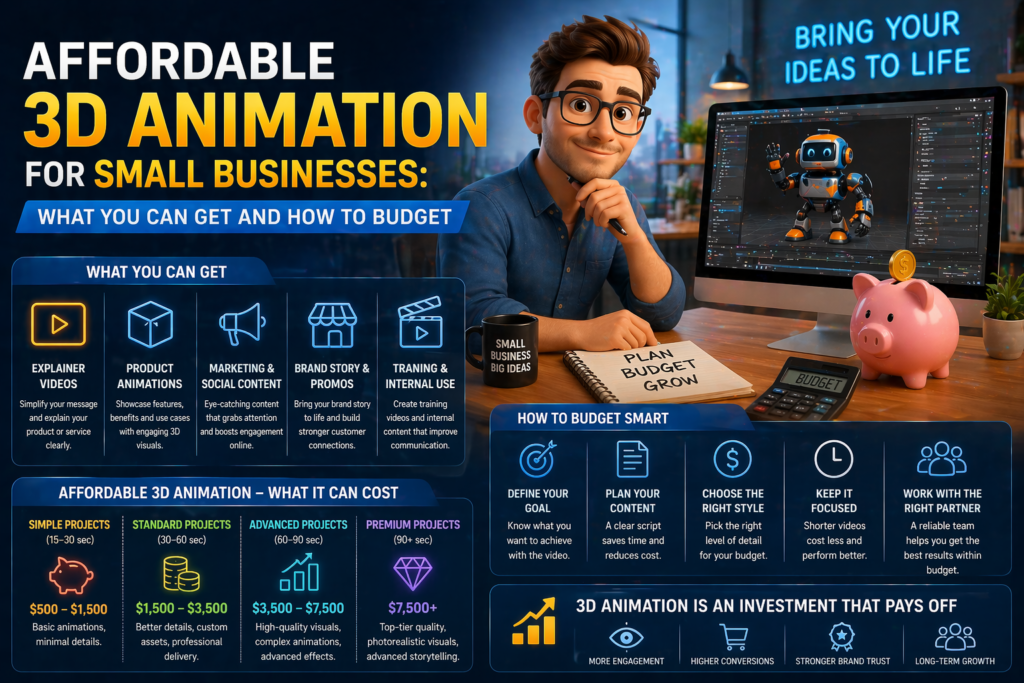
Before budgeting, it is worth being specific about what 3D animation is actually capable of doing for a business of your size. The following use cases represent the highest-ROI applications of 3D animation for small and growth-stage businesses.
Product Visualization That Competes With Established Brands
If you sell a physical product, 3D animation allows you to present it with the same visual authority as brands with professional photography studios and dedicated creative departments — without owning any of that infrastructure. A professionally produced 3D product visualization on your website, your product listing, or your ads levels the visual playing field in a way that matters: it removes the visual disadvantage that small brands typically face against larger competitors.
Explaining a Complex or Innovative Product
If your product does something that is difficult to explain without showing it — a mechanism, a process, a unique feature, a technology — 3D animation is often the only format capable of communicating it clearly. A startup with a novel product and a small sales team can replace dozens of explanatory sales calls with a single well-produced 3D explainer. The time value of that efficiency is significant.
Creating a First Impression That Earns Credibility
For businesses without an established brand reputation, the quality of your visual communication does disproportionate credibility work. A small business with high-production-quality 3D animation on its homepage, in its pitch deck, or in its advertising is perceived differently than one relying on stock photography and amateur video. For founders pitching investors, brands entering competitive retail categories, and B2B businesses competing for enterprise clients, this credibility signal has direct commercial value.
Building a Reusable Content Asset
Unlike photography, which ages, requires reshooting for variants, and cannot be easily repurposed across formats, a 3D animation asset is a permanent, reusable content infrastructure. A single 3D product model, once produced, can generate stills for your website, a video for your product page, a cut-down for social ads, and an AR viewer for e-commerce — across every product variant and in any color option — without additional production cost. For small businesses managing lean content budgets, this reusability is transformative.
What Small Businesses Can Get at Different Budget Levels
The following framework is calibrated to the U.S. market in 2026 and reflects what professional studios — not freelance platforms — deliver at each investment level. These are honest ranges, not aspirational figures.
| Budget | What a Small Business Can Realistically Get |
| $2,500 – $5,000 | A clean 3D product turntable animation (single product, neutral background, 15–20 seconds). Polished stylized finish. Suitable for product page, social media, and email. Limited environment; one product variant. |
| $5,000 – $10,000 | Photorealistic or high-quality stylized product visualization with environment (one scene). 20–30 seconds. Multiple format deliverables (web, social, 9:16 cut). Still renders included. One round of color/variant options. |
| $10,000 – $20,000 | A short 3D explainer animation (45–75 seconds). Multiple scenes. Character or product focus. Professional voiceover and music. Multiple deliverable formats. Suitable for website hero, investor pitch, or brand launch. |
| $20,000 – $40,000 | A full 3D brand film or product campaign (60–90 seconds). Cinematic quality. Multiple scenes and environments. Full audio design. Campaign derivatives (15-second cut, social formats). Reusable 3D asset library. |
A practical note on the lower end of these ranges: $2,500–$5,000 buys a specific, narrow deliverable from a professional studio. It does not buy flexibility, multiple concepts, or extensive revision. If your budget sits here, the path to a good outcome is a very clear brief and realistic expectations about scope.
Where Small Businesses Commonly Overspend — and Underspend

Overspending: Choosing the Wrong Format for the Brief
One of the most common ways small businesses waste their animation budget is commissioning a more complex or longer animation than the brief actually requires. A 90-second fully animated brand film is impressive — but if what you needed was a 20-second product visualization for your product page, you have spent three times as much as necessary for the actual commercial objective. Scope your animation to the specific job it needs to do.
Overspending: Not Providing Clear References
Studios price risk. When a brief is vague about visual style, creative direction, or quality benchmark, studios include a risk buffer in their quote. Providing two or three specific visual references — even from other industries — can materially reduce your quote by removing that uncertainty. A client who arrives with a clear brief and specific references is a lower-risk engagement for any studio.
Underspending: Choosing a Freelancer to Save Money
The headline rate on a freelance platform looks compelling against a professional studio quote. The full cost — in project management time, revision cycles, quality inconsistency, and the risk of incomplete delivery — often closes that gap entirely. For a small business where the marketing leader is also managing seven other priorities, the overhead of managing a freelance animation engagement poorly is a real and significant cost.
Underspending: Treating Animation as a One-Off Rather Than an Asset
Small businesses that commission a single product animation without a plan for the underlying 3D assets are leaving significant value on the table. When you commission 3D animation from a professional studio, ensure your contract includes ownership of the 3D project files or, at minimum, a high-resolution master that enables format derivatives. Those assets are the foundation of your content infrastructure — their value compounds over time.
How to Budget for Your First 3D Animation
If you are approaching your first 3D animation project, the following process will help you arrive at a realistic, defensible budget.
- Step 1 — Define the objective: What specific commercial outcome do you need this animation to produce? Be precise. ‘Improve our website’ is not an objective. ‘Reduce the bounce rate on our product page and improve add-to-cart rate’ is an objective.
- Step 2 — Define the use case: Where will this animation live? Product page, paid social, email campaign, trade show, investor pitch? Each context has different format and quality requirements.
- Step 3 — Define the minimum viable scope: What is the simplest version of this animation that would achieve the objective? Start there. You can always expand scope — overshooting it on the first project is expensive and common.
- Step 4 — Get two to three professional quotes: Approach two or three studios with your brief and compare quotes. Look for alignment between scope and deliverable, not just headline price.
- Step 5 — Evaluate based on return, not cost: If a $12,000 product animation reduces your return rate by 1.5% on a product line generating $800,000 a year, the payback period is less than three months. Calculate the return before making the budget decision.
Choosing the Right Studio for a Small Business Budget
Not all studios are equipped to serve small business clients effectively. A studio built primarily for enterprise production may lack the flexibility, communication style, and billing structure that a small business engagement requires. When evaluating studios at the growth stage, look for the following.
- Clear scope and milestone documentation from the first proposal
- Experience producing animation for businesses of comparable size — ask for examples
- Defined revision policy included in the base quote
- Transparent asset ownership terms — you should own your 3D files
- Responsiveness in the pre-sales process — a reliable predictor of communication in production
- A portfolio that includes work at or near your target investment level, not only their flagship high-budget productions
Small Businesses That Invest Strategically in 3D Animation Grow Faster
The small businesses seeing the highest returns from 3D animation investment are not those with the largest marketing budgets. They are those that make the investment with a clear commercial objective, scope the project to the minimum necessary to achieve that objective, manage the production process professionally, and treat the resulting assets as the beginning of a content infrastructure rather than the end of a project.
That approach is available to any business at any budget level. The format is more accessible than it has ever been. The businesses that act on that accessibility now will hold a visual content advantage over competitors who wait.
3D Animate US works with small businesses and growth-stage brands across the United States to produce 3D animation that fits both the brief and the budget. Contact our team for a free consultation — we will tell you honestly what is achievable within your parameters and help you scope a project that delivers real commercial value.