
Timeline is one of the first questions every business asks when evaluating a 3D animation project — and one of the least reliably answered by studios who either quote an optimistic figure to win the brief or hedge so broadly that the answer provides no useful information.
This article gives you honest, specific timelines for the most common types of 3D animation projects, explains the variables that compress or extend those timelines, and tells you what you can do as a client to keep your production on schedule. The goal is to give you the information you need to plan a 3D animation project realistically — not to make animation sound faster or more accessible than it actually is.
The Short Answer — and Why It Is Incomplete
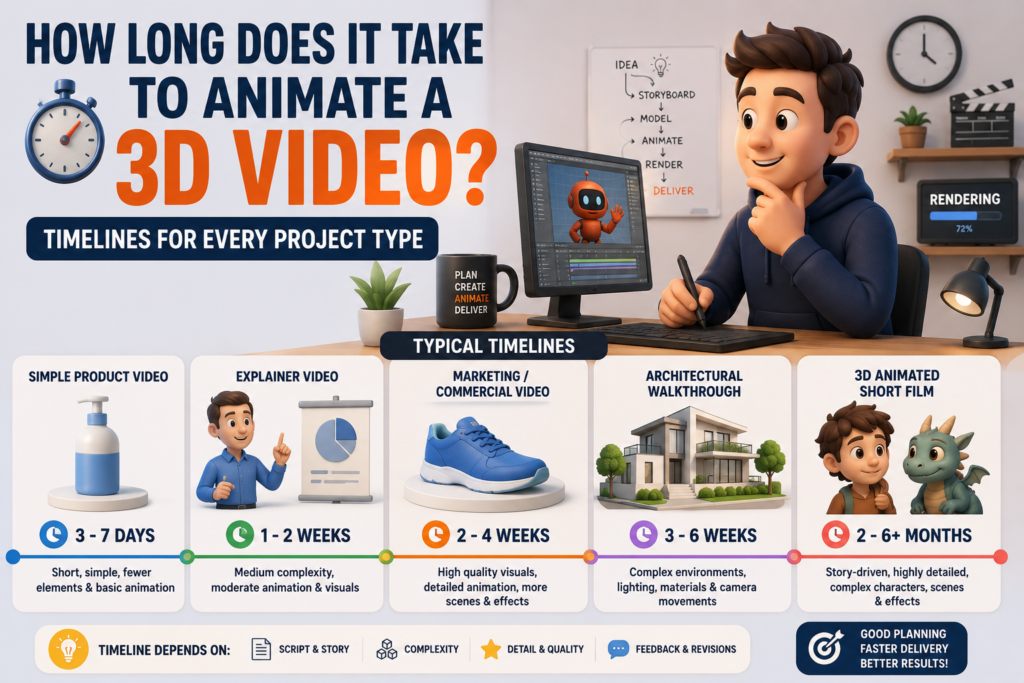
The honest short answer to ‘how long does 3D animation take?’ is: between three weeks and six months, depending on the type of animation, its duration, its visual complexity, the quality standard required, and how efficiently the client review process is managed.
That range is wide enough to be almost useless as a planning tool. The more useful answer requires understanding how the major variables interact — which is what the rest of this article addresses.
The Variables That Determine 3D Animation Timeline
Type of Animation
Different animation types have fundamentally different production requirements, and those requirements translate directly into timeline. A simple product turntable — a single product rotating in a neutral environment — can be produced in three to four weeks because the modeling scope is limited, there is no rigging, and the lighting and rendering are straightforward. A character-led brand film with multiple environments and expressive character performance can take four to six months because every phase of the pipeline is operating at its maximum complexity.
Duration of the Final Deliverable
Longer animations take longer to produce — but the relationship is not linear. The majority of production cost and time in a 3D animation is front-loaded in modeling, rigging, and scene setup. Doubling the duration of an animation from 30 to 60 seconds does not double the timeline; it adds perhaps 30–40% to the animation and rendering phases while leaving the front-end phases largely unchanged.
Level of Photorealism
Photorealistic rendering is computationally and artistically intensive. A stylized or semi-realistic animation — with flat or cel-shaded materials, simplified lighting, and non-photorealistic rendering — can be produced significantly faster than a photorealistic equivalent because the texturing, lighting calibration, and rendering time are all substantially reduced. If timeline is a binding constraint and your brief can accommodate a stylized aesthetic, this is the most effective scope reduction available.
Client Review Efficiency
This is the most underestimated timeline variable — and the one that clients have the most direct control over. Every production milestone requires client review and approval before the next phase begins. If reviews are conducted quickly, with consolidated feedback from all stakeholders, the production moves at its natural pace. If reviews are delayed — by stakeholder availability, internal approval processes, or vague feedback that requires clarification — the timeline extends accordingly, and the extension is always the client’s budget of time to spend, not the studio’s.
In a standard professional production, the studio’s production time typically accounts for 60–70% of the total elapsed timeline. The remaining 30–40% is client review time. Businesses that manage their review process efficiently — with consolidated feedback and timely approvals — consistently see faster delivery than those who do not, with no change in the studio’s production pace.
| The single most controllable timeline variable in any 3D animation project is how quickly the client reviews work and how clearly they communicate their feedback. Studios cannot work faster than their clients approve. |
Timelines by Project Type
| Project Type / Description | Typical Professional Timeline |
| Simple product turntable (single product, neutral bg, 15–20 sec, stylized finish) | 3–4 weeks |
| Product visualization with environment (30 sec, photorealistic or high-quality stylized, 1–2 scenes) | 5–7 weeks |
| Short 3D explainer (45–75 sec, 2–4 scenes, character or product focus, voiceover) | 7–10 weeks |
| Multi-scene product campaign (60–90 sec, multiple environments, multiple deliverable formats) | 10–14 weeks |
| Character-led brand film (60–90 sec, performance animation, full audio production) | 14–20 weeks |
| Architectural walkthrough (60–90 sec, exterior + interior, photorealistic Arnold rendering) | 8–12 weeks |
| Medical or scientific visualization (60–90 sec, biological or mechanical accuracy required) | 10–16 weeks |
| Social media animation package (3–5 short assets, 10–20 sec each, campaign derivatives) | 4–7 weeks |
| Enterprise training animation (per module, 3–5 min, technical accuracy required) | 12–18 weeks |
These timelines assume a professional studio with dedicated production capacity, a well-prepared brief, and an efficient client review process. They represent elapsed calendar time from project kickoff to final delivery — including all review rounds within standard scope.
What Compresses a Timeline — and What It Costs
Most timeline compression is achievable — at a cost. The following approaches can shorten a standard production timeline, each with its own implications.
Rush Production Premium
Professional studios can prioritize a project ahead of their standard queue, allocate additional artist hours, and expedite render farm processing. This is genuine timeline compression — not just a promise. It is also a direct cost. Rush premiums for significant timeline compression typically range from 20% to 50% above standard production cost, depending on the degree of compression required and the studio’s current capacity. If a six-week production needs to be completed in four, the additional resource allocation required to achieve that compression is reflected in the quote.
Scope Reduction
The most cost-neutral form of timeline compression is scope reduction: fewer scenes, shorter duration, simpler visual treatment, reduced number of variant deliverables. A business whose campaign deadline requires a four-week delivery can often achieve a production that serves its core commercial objective within that timeline — but it requires the discipline to scope to that timeline rather than to the ideal deliverable. This conversation is most productive before the brief is finalized, not after the quote has been approved.
Parallel Production Tracks
Some production phases can be run in parallel rather than sequentially. Modeling and pre-production on Phase 2 assets can begin while Phase 1 assets are in rendering, for example. This requires a larger simultaneous team allocation and therefore carries a cost premium — but it can compress overall elapsed timeline without requiring significant scope reduction.
What Extends a Timeline — and How to Prevent It
The most common timeline extensions in 3D animation production are client-driven, not studio-driven. The following are the most frequently occurring and most avoidable.
- Late or unconsolidated feedback: Every day a WIP review sits unapproved is a day of production delay. Establish internal approval processes and review deadlines before production begins, and treat them as seriously as external production milestones.
- Scope changes mid-production: Adding scenes, changing the product, altering the visual direction, or expanding the deliverable set after production has begun are the most expensive and timeline-damaging changes a client can make. Invest in the brief to prevent them.
- Multiple stakeholder approval chains: Projects that require sequential approval from multiple stakeholders — legal, brand, product, executive — accumulate review time at each stage. Map the approval chain before production begins and build its total time into the production calendar.
- Reference gaps in the brief: Productions that begin without complete product reference — photography, CAD files, material specifications — require rework when the missing reference is provided mid-production. Front-load the reference gathering before kickoff.
- Changing the brief after animatic approval: The animatic is the last affordable change point. Changes after animatic approval require rework of completed high-quality production work, extending timelines in proportion to the scope of the change.
Build the Timeline Into the Brief
The most reliable way to ensure a 3D animation project delivers on time is to build the timeline into the brief before approaching studios — working backward from the required delivery date to establish the latest feasible production start date, and then verifying that the production scope is achievable within that window before commissioning.
If the scope is not achievable within the available timeline at standard production cost, you have three options: compress the scope, accept the timeline compression premium, or extend the delivery date. All three are legitimate choices. The choice you cannot make is to commission a full-scope production on a compressed timeline at standard cost and expect the studio to absorb the gap. Professional studios do not work that way — and those that claim to are managing expectations, not production realities.
3D Animate US provides detailed timeline estimates for every project type as part of the quote process. Contact our team with your brief and delivery date — we will give you an honest assessment of what is achievable within your window.